
A rare little fish once swam confidently through the peat-stained waters of the Nuwejaars River and its tributaries – its red fins a sign of a healthy ecosystem.
But over the years, the Heuningnes redfin (Pseudobarbus sp. nov. ‘Heuningnes’) vanished from many of these waters, pushed to the brink by invasive alien fish species and habitat loss.
Now, in a pioneering conservation effort, the Nuwejaars River Nature Reserve’s Fynbos Fish Project is working to bring these redfins home.
In partnership with the Fynbos Fish Trust, in a project supported by the Mohamed bin Zayed Species Conservation Fund (and with all the necessary permits in place from CapeNature), the Fynbos Fish Project team has begun catching and releasing Heuningnes redfins into two specially selected fish sanctuaries within the Nuwejaars Wetlands Special Management Area (NWSMA).
Here, these small but mighty fish will be left undisturbed to breed, ensuring that the next generation of redfins will be ready to return to the river systems they once called home.
“Seeing these fish back in the river system is a sign of hope,” says Erica Brink, Conservation Manager for the Nuwejaars River Nature Reserve. “It’s a small fish, but it has a big story to tell about how we can restore our rivers, wetlands and the biodiversity that depends on them.”
These fynbos fish species have survived in these waters for millions of years. However, their numbers have dwindled in recent decades, to the point that they are now listed as Endangered on the South African National Biodiversity Institute’s Red List. They are currently being formally described by the NRF-South African Institute for Aquatic Biodiversity (SAIAB) and their redlist status could change as this process is formalised.
Aside from invasive fish species, Heuningnes redfins are also now facing a brand new threat: that of a changing climate. Recent floods have degraded tributaries into the Nuwejaars River where these fish used to occur, impacting on their ability to survive in these pools and streams.

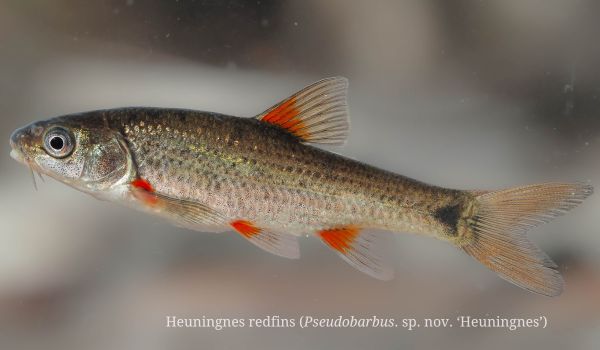

Now the plan is to reintroduce the redfins from the fish sanctuaries into areas of the Nuwejaars River and its tributaries where they have become locally extinct.
This will give them a fighting chance to reclaim their place in the ecosystem. This innovative strategy was developed by the Fynbos Fish Trust through funding support from Fondation Segré through IUCN Save Our Species in 2024.
Meanwhile, the fynbos fish team, Breyton Murtz and Deon Newman, have been hard at work monitoring the river systems, tracking down remaining populations of redfins and assessing water quality and habitat conditions. Their work has even taken them beyond the boundaries of the Nuwejaars Wetlands SMA, into the Kars and Hansies Rivers, where they have found encouraging signs of redfin survival.
Our work isn’t over
“It’s been incredible to see these fish in areas where we thought they were gone,” says Erica. “But it’s also a reminder that our work isn’t over. We need to keep restoring these waterways and protecting them if we want the Heuningnes redfin to thrive again.”
The project is about more than just a single fish species. By restoring habitats for the redfins, the team is also improving water quality and ecosystem health, benefiting not only other fynbos fish species such as Heuningnes galaxias (Galaxias sp. nov. ‘Heuningnes’) and Sandelia capensis, but also everything from frogs to waterbirds, and supporting the resilience of the Agulhas Plain’s unique biodiversity.
With continued monitoring, habitat restoration, and the support of incredible donors, the Nuwejaars River Nature Reserve is working to ensure that this small fish will once again ripple through the waters of the Nuwejaars system, a living symbol of restoration in action.

Images supplied by LoveGreen Communications.
